A spring blizzard moved through quickly March 26, leaving behind sunny skies, either bare ground or snow banks and sea ice on exposed coasts after storm to hurricane force winds. As in February 2013, Swallow Tail took the brunt of the storm but the quick movement of the storm resulted in some sea ice frozen across the peninsula but not nearly as thick as in 2013.
Power was out on the point for 24 hours after the salt spray tripped a breaker on the pole (over 36 hours in 2013). Two of four webcams no longer work after the wind, salt spray and power outages took their toll. The antenna for the WiFi for the ferry blew off the boathouse, laden down with ice. The poor flag that was flown for the first time only two weeks ago is now a tattered shred, despite reinforcing the outer edge.
Here are some photos:
Ice covered northern side of the boat house.
WiFi antenna blown off the boathouse, covered in ice.
Thickness of ice on lighthouse.
Frozen sea ice on bell house attached to lighthouse. Ice froze horizontally as the spray was blown across the building wall. Taken by Sarah McDonald.
Ice covered railings leading to bronze fog bell.
Ice covered rope safety lines along foot path.
Ice and snow on bronze fog bell.
Ice covered wooden bench facing away from freezing salt spray.
Ice covered wooden bench facing freezing salt spray.
Ice covered fog horn.
North side, roof and chimmeys of keepers house covered in ice. A couple of shingles lifted on the roof replaced in 2011.
Swallow Tail peninsula covered in sea ice.
Ice covered iron eye ring and vegetation.
Icy sign post with Sarah taking photos from below.
Photo taken by Sarah McDonald of sign post.
Frozen sea ice on the railings for the steps.
Ice covered trees near the Sawpit. No wonder they don't grow branches facing the water.
Windows in the keepers house covered in ice on the outside.
Tattered flag after flying for only two weeks.
Web cameras on Welcome Centre - only two still are working after wind and power outages.
We were very disappointed when one of the wooden lobster trap style benches went missing this spring. It was situated to the east of the lighthouse and was a favourite for many people. We had looked from above and from the water but couldn’t find it.
Wooden lobster trap style bench. Each one has a unique, spectacular view.
This August, a family from Holland were exploring below the lighthouse on the rocks and found the bench lodged in a crevice. We were able to recover the bench and on the climb back up, the clapper mechanism for the fog bell was also discovered in the rocks. It is a bit bent but should be fixable. This was the last clapper mechanism for the bell and stood to the side of the bell and hit the bell on the outside. A chip developed in the bell because of it.
Fog bell and external clapper mechanism. Photograph taken by Mary Catherine Edwards in the mid-1960s.
Divots in the rim of the fog bell caused by external clapper.
Earlier clapper that hung inside the fog bell. Photograph provided by Jodie Graham.
An earlier clapper that hung under the bell was also recovered in 2009 when the soil was removed from around the lighthouse as part of the soil mediation project to remove lead and bismuth, components of paint prior to 1970. The clapper had been left on the ground and gradually disappeared as the grass grew over it.
Ken Ingersoll putting the final touches on the wooden lobster trap style bench where it was located near the lighthouse.
The bench survived with only minor damage to some of the boards. It is now sitting on the keepers house deck. Another bench was built to replace this one when we didn’t realize the bench was just in hiding!
People using the replacement bench near the lighthouse, which is bolted to the rocks.
Rescued wooden lobster trap style bench now located on the keepers house deck.
We are pleased to have a wide range of interpretation panels now installed at Swallow Tail for our visitors. Through funding from the Canadian Heritage Building Communities Through Arts and Heritage Legacy Fund, we were able to add outdoor interpretive panels for self-guided tours year round. We also have some wonderful hand painted signs for directions and other information. A memorial plaque was installed in 2011 to mark the 75th anniversary of the tragic death of one of the light keepers, Elodie Ingalls Foster.
New sign welcoming visitors to Swallow Tail. The Welcome Centre is also a gift shop. The deck affords lovely views and has one of several picnic tables in this area.
The new signs include a Welcome to Swallow Tail and site map. The spelling of Swallow Tail has varied over the years and we have opted for the older spelling in our signs, where the name more accurately refers to the origins of the name referring to the shape of the peninsula, reminiscent of a swallow’s tail with the curve of the wings in the surrounding coves. The site map positions Swallow Tail in relationship to Grand Manan and the Bay of Fundy and local points of interest. A sign post near the boat house also compliments this information, pointing to various areas, including distance in some cases, that can be seen from Swallow Tail.
Site sign for Swallow Tail located near the stairs. The new safety railing can be seen in the background which defines another picnic area and seating.
All of the buildings have a sign that includes a brief history of the structure. In addition, there is information about the fog bell. Various types of fishing can be seen at different times of the year from Swallow Tail and a panel describes some of these. The new floating weir has been a topic of conversation and there is a separate post about it. Many types of marine life can be seen as well and these are illustrated on another panel. Geology of the area is also described including the large mafic dike that the footbridge straddles. Grand Manan has the great opportunity for people to have one foot on rock over 200 million years of age (MYA) and also one foot on rock over 500 MYA. Finally there is a bit of a discussion about the weather conditions, what it does to the vegetation and why it is more evident at Swallow Tail.
Many of the signs are clustered around the keepers buildings where people pause and take in the information. Each building also has a short description of its history.
The fog bell has its own interpretative sign giving its history.
The geology panel is near the footbridge, appropriately attached to one of the large rock outcrops.
Memorial panel and the history of the lighthouse are located near the entrance to the tower.
People enjoying the view sitting beside the sign post near the boat house.
While the site is beautiful and extremely awe-inspiring, there are a few hazards and with the number of visitors it is also necessary to point out some courtesies that would make everyone’s visit pleasant. These are summed in a sign by the stairs and are worth repeating here:
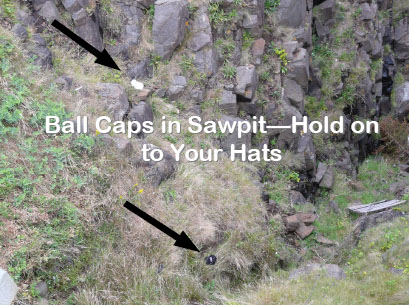
The wind is always stronger on the peninsula – the loss of several hats in the Sawpit last summer can attest to that.
The trails can be icy in the winter and may not be passable after a heavy snowfall.
Footpath after February snow storm and 2.5 hours of shovelling.
It is always best to carry out any garbage because items left lying outside can be blown into the ocean. In the summer there is a garbage can in the parking area which is emptied regularly.
To respect others and for the safety of your pet, it is always best to have dogs on a leash. Not everyone picks up after their dogs which makes it unpleasant for others using the trails, particularly when it is left in the middle of the footpath.
Caution sign at stairs.
There are a few sharp drop offs and if you venture beyond the marked paths, you should be aware of this and take necessary precautions. It is a long walk back with an injury.
We hope that everyone enjoys the information and the panels help answer some frequently asked questions.
Part of a double rainbow that formed in October 2012
With spectacular weather, a group of nearly 100 people walked out to the keepers house at Swallow Tail on July 7th, the 152nd anniversary of the light house first being lit. Two RCMP officers were present, along with the Honourable Rick Doucet, the MLA for the area and Kirk Cheney representing the Village of Grand Manan who have been very supportive of the restoration efforts at the Swallow Tail light station and are in the process of reconsolidating the light station with the acquisition of the light tower in the near future.
RCMP officers breaking flag at annual flag raising
After a brief welcoming, Wayne Clifford, John Peacock, MJ Edwards, Millie and Alexandre Banks played an impromptu piece on the bronze fog bell, returned to the property in November 2011. The new deck around the bell acted as a natural stage for the event. Members of Before the Mast (http://www.beforethemastseashanties.com/) continued with two songs before everyone was given a chance to play the bell if they wished.
The Lahey Family was represented to commemorate the 100th anniversary of the beginning of 22 years of service by George Lahey as light keeper . The Dalzell family regrettably could not make the event which also marked the 100th anniversary of the retiring of George Dalzell as light keeper after 19 years of service.
Before the Mast helping celebrate the Swallow Tail light station anniversary
The descendants of the late light keeper, George Lahey, ringing the fog bell
Despite damage from many years of use and also being moved several times, the bell sounded wonderful and could be heard beyond the peninsula. Listen to three different strikes of the bell here: http://www.freesound.org/people/bob.burgess/sounds/160882/
As part of a grant from the Legacy Fund of Heritage Canada, celebrating the 150th Anniversary of Swallowtail Lighthouse, we have been renovating the trails and preparing a tribute to the lightkeepers. Part of this includes returning the bronze fog bell that was used for many years to alert mariners in times of restricted visibility. With the propensity of fog in the Bay of Fundy, many months of the year, fog alarms were as important as the light.
Bell house prior to 1922 at the extreme easten end of the peninsula.
The photo was posted to the Facebook group - Old Grand Manan Photos
Reference to the fog bell begins in 1915 when a building was built at the extreme end of the Swallow Tail peninsula, although the date on the bell is 1904. In 1922, the bell was moved to sit beside the lighthouse to make it easier for the light keepers to keep the winding mechanism operating which in turn rang the bell. Originally, fog bells, horns, guns were only sounded in response to a fog horn or bell from a passing vessel but with the development of an automated system, similar to what is used with spring wound clocks, the fog bell could be sounded throughout inclement weather that restricted visibility.
Close-up of bell house on northern side of lighthouse. Elmer Wilcox photo, 1958.
Bell house and fog bell on northern side of Swallowtail light house. Elmer Wilcox photo, 1958
Both the bell and the bell house were moved to the northern side of the lighthouse where the bell sat until 1980. A fog horn had replaced the fog bell at an earlier time. The bell had developed a small crack where it was continuously rung and the tone of the bell had changed. The lightkeeper at the time, Grimmer Ingersoll, organized the removal of the bell from the point to the Grand Manan Museum where it sat in front of the Deep Cove School House. Moving the bronze bell was not an easy feat. At 900 kg (2000 lbs), it took brute force and lots of ingenuity to accomplish the task. Unfortunately, the bell did suffer some damage when it was moved in 1980 and two chips can be found on the edge of the bell where chains were wrapped around it.
Light keeper, Grimmer Ingersoll, and friends moving bell in 1980,
eventually getting it to the Grand Manan Museum
When the Swallowtail Keepers Society was formed in 2008, the Museum agreed to donate the bell back to Swallowtail. A large deck was built by Terry Davidson, George Best and Ken Ingersoll, over the concrete base of the old flag pole and a stand was attached to hold the bell. Repairs had to be made to the top of the bell and modified to include an eye and shackle for lifting. Michael Brown of Waterfront Fabricating drilled through 6.5 inches of steel at the top of the bell to install two new plates and an eye. The bell originally had two bolts that held the bell on an I-beam but these were not appropriate if the bell was to be lifted and then lowered onto the stand. The bell could have been strung in a cargo net but that complicated the moving process and recovering the cargo net afterwards, given the weight of the bell.
Terry Davidson and George Best beginning the bell deck
Finished bell deck awaiting the bell
Once the bell was ready to be moved, Randy Brownlee and the M.G. Fisheries boom truck picked up the bell and drove it to the top of the hill at Swallowtail, leaving only 300 m (1000') to move the bell but with 54 steps, a wooden foot bridge, a gravel path over undulating terrain, and a flight of stairs up to the deck, that was not an easy feat.
M.G. Fisheries boom truck that moved the bell from the Grand Manan Museum
to the top of the stairs leading to Swallowtail. Randy Brownlee photo.
Inquiries went out to the Canadian Coast Guard and a military base to see if they might be able to use one of their helicopters to move the bell. No promises were made but it was suggested that if everything was in place, if a helicopter was available, it might happen. In the middle of November, the Canadian Coast Guard needed their heavy lift helicopter to move building material to Partridge Island in Saint John, NB to construct a new helicopter pad. Since that is only 25 minutes by helicopter, we were asked to be ready on short notice. A call at 8:30 on November 21 set the final process in motion. The helicopter would arrive at 1:30 to move the bell. This in part was to take advantage of the decreasing wind in the afternoon and to allow myself to be present since I was booked to make a right whale aerial survey the next day with the Fisheries and Oceans Canada as part of the Lobster Mitigation program for Lobster Districts 36, 37 and 38. locations of right whales are provided to lobster fishermen to help them avoid conflicts with right whales and their fishing gear.
Calls were made to a few people to pass the word about this special event. Over a dozen people watched as the helicopter arrived to survey the pick up location and the bell deck. Because of the weight of the bell, only the pilot and one crew member was aboard to do the lifting. One person was at the bell to hook up the cable and two were at the bell deck to position the moving bell onto the stand.
Jamie McCavour grabbing hook from Canadian Coast Guard helicopter
Jamie McCavour, Canadian Coast Guard, hooking up cable to bell before lifting
With great anticipation and a bit of trepidation hoping that nothing would happen and the bell wouldn't be lost into the ocean, the helicopter moved into position. The bell slowly rose off the wooden pallet where it had been sitting. The pilot then took a long wide circle to approach the bell stand from the south, just as the Grand Manan Adventure ferry rounded Swallowtail. After a few false approaches, the bell finally was positioned accordingly and was quickly unhooked from the helicopter. A cheer went up from the onlookers.
The Grand Manan ferry, Grand Manan Advenutre going around Swallowtail as bell
was being brought in a wide arc to the bell deck. Note the bell house is attached to the lighthouse.
Bronze fog bell lifting into air. Martha Eaton photo.
Canadian Coast Guard helicopter taking bronze fog bell to the bell deck in a wide arc.
Steve Lloyd and Bob Hebert (Canadian Coast Guard) coordinating the landing of the fog bell on the stand
Bob Hebert (Canadian Coast Guard) unhooking the cable on the fog bell once it was positioned on the stand.
Here are two videos taken of the move
(pick up of the bell from the top of the hill by the Coast Guard helicopter).
I walked down to the see the bell in position and had a great sense of accomplishment as I came over the rise and saw the bell. While the bell is slightly off centre, that can be fixed. I took great pleasure in ringing the bell for the first time since it had been removed from Swallowtail. The tone echoed nicely and while I don't have perfect pitch, the tone is supposed to be an F, according to the manufacturer, Meneely Bell Company of West Troy, NY.
Canadian Coast Guard crew - Bob Hebert, Jamie McCavour, Paul Mosher (pilot) and Steve Lloyd
April 19-20. Earth Day work weekend at Swallowtail. April 26-27 weather alternative.
May 24. Before the Mast Benefit Concert. Covert Hall. 7 pm.
July 1. Welcome Centre opens for the summer.
July 5. Lobster roll dinner and music (Fund-raiser). Grand Manan Curling Club. 6-9 pm. Reservations recommended.
July 7. Flag raising at Swallowtail to commemorate the 154th Anniversary. 2 pm weather dependent. Lighthouse Open House.
August 7. “A Tale of Two Lighthouses: The Saved & The Lost” (Swallowtail & Fish Fluke Point). Talk at the Grand Manan Museum. 7:30 pm. Laurie Murison and MJ Edwards.
August 15, 16, 17. International Lighthouse/Lightship weekend. Amateur radio operators set up at lighthouses and light ships around the world and attempt to communicate with each other via Ham Radio. Come join Sterling, Rick and Art at Swallowtail.
Laurie Murison is the chair of the Swallowtail Keepers Society, a community dedicated to the safeguarding and preservation of Grand Manan's historic light stations.