Showing posts with label keepers house. Show all posts

Thursday, March 27, 2014

2014 Sea Ice Storm

A spring blizzard  moved through quickly March 26, leaving behind sunny skies, either bare ground or snow banks and sea ice on exposed coasts after storm to hurricane force winds.  As in February 2013, Swallow Tail took the brunt of the storm but the quick movement of the storm resulted in some sea ice frozen across the peninsula but not nearly as thick as in 2013. 

Power was out on the point for 24 hours after the salt spray tripped a breaker on the pole (over 36 hours in 2013).  Two of four webcams no longer work after the wind, salt spray and power outages took their toll.  The antenna for the WiFi for the ferry blew off the boathouse, laden down with ice.  The poor flag that was flown for the first time only two weeks ago is now a tattered shred, despite reinforcing the outer edge.

Here are some photos:

Ice covered northern side of the boat house.

WiFi antenna blown off the boathouse, covered in ice.

Thickness of ice on lighthouse.

Frozen sea ice on bell house attached to lighthouse.  Ice froze horizontally as the spray was blown across the building wall.  Taken by Sarah McDonald.
Ice covered railings leading to bronze fog bell.

Ice covered rope safety lines along foot path.

Ice and snow on bronze fog bell.

Ice covered wooden bench facing away from freezing  salt spray.

Ice covered wooden bench facing freezing salt spray.

Ice covered fog horn.

North side, roof and chimmeys of keepers house covered in ice.  A couple of shingles lifted on the roof replaced in 2011.

Swallow Tail peninsula covered in sea ice.

Ice covered iron eye ring and vegetation.

Icy sign post with Sarah taking photos from below.

Photo taken by Sarah McDonald of sign post.
Frozen sea ice on the railings for the steps.

Ice covered trees near the Sawpit.  No wonder they don't grow branches facing the water.

Windows in the keepers house covered in ice on the outside.

Tattered flag after flying for only two weeks.

Web cameras on Welcome Centre - only two still are working after wind and power outages.

Saturday, December 15, 2012

International Lighthouse and Light Ship Weekend

Sterling Carpenter, Art McKay and Rick MacMillan stayed at the keepers house August 17-19 to again participate in the annual International Lighthouse and Lightship Weekend (http://illw.net) . They set up their radios and tried to contact as many other amateur radio operators also set up at lighthouses around the world. Swallow Tail has its own call numbers: VE9SJH


Sterling Carpenter and Rick MacMillan setting up the antennae at Swallow Tail

Running the wires for the short wave radio antennae
 
Rick MacMillan testing his short wave radio
They have been with the Swallow Tail project for several years now and appreciate the improvements every year. They are avid campers and have put up with the living conditions in the keepers house in the past but they were pleasantly surprised by an operational kitchen and bathrooms, no plywood on the windows, more furniture, and the new picnic tables and benches.

Wednesday, November 28, 2012

Returning the Storm Windows to the Keepers House


Keepers house as it looked in the spring of 2008 with boarded windows and peeling paint.
We were very pleased to have 21 custom-built wooden storm windows constructed and installed in the keepers house this September. We had salvaged a few storms that had not been discarded in the past but were still short most of the storms.


One of the original storm windows for the keepers house that was stored in the boathouse.
On the upper storey, the storm windows had been replaced with aluminum storms in the 1970s but these storm windows had been removed after the light station was destaffed and the house was operated as a Bed and Breakfast. This caused all sorts of water damage in the house over the years because of the extreme weather on the Swallow Tail peninsula which is unforgiving, and without storm windows, the original wooden windows could not be kept waterproof. Re-glazing these windows certainly helped but the storm windows were really necessary. Taking down the plywood for the last time, knowing that this would not compromise the interior of the house was a real pleasure.

New wooden storm windows being painted.
Wooden windows are not easy to purchase anymore with most people preferring vinyl. However, vinyl window inserts are not part of the history of the buildings and in keeping with the age of the structure, we had the storm windows constructed by Schell Lumber in Ontario. They still have all the equipment to make wooden windows and do a great job. The fellow who makes the windows is 83 and can turn them out very quickly.  Tom Murison, who is a restoration architect in Ontario, delivered the windows and craftfully installed them.
Tom Murison fitting new wooden storm windows with Michael Anderson looking on.
Each window had to be painted before installation. Although all the windows are of similar dimensions, slight variations occur and each window had to be fitted. Hinges were attached at the top so they could be pushed open to allow air flow in the summer but still protect the inner windows. We sealed them for the winter just to be on the safe side. 

Tom Murison installing hinges on new wooden storm windows.
The last windows that need to be addressed are the two sliding patio doors installed when the house operated as a Bed and Breakfast and gave access to the deck. We hope to install French doors that look like the original windows but still allow that access.

Keepers house as it looked in 1986, just after the lightstation was destaffed.

Monday, November 26, 2012

Self-Guided Tours Using Interpretative Panels

We are pleased to have a wide range of interpretation panels now installed at Swallow Tail for our visitors. Through funding from the Canadian Heritage Building Communities Through Arts and Heritage Legacy Fund, we were able to add outdoor interpretive panels for self-guided tours year round. We also have some wonderful hand painted signs for directions and other information. A memorial plaque was installed in 2011 to mark the 75th anniversary of the tragic death of one of the light keepers, Elodie Ingalls Foster.

New sign welcoming visitors to Swallow Tail.  The Welcome Centre is also a gift shop.  The deck affords lovely views and has one of several picnic tables in this area.
The new signs include a Welcome to Swallow Tail and site map. The spelling of Swallow Tail has varied over the years and we have opted for the older spelling in our signs, where the name more accurately refers to the origins of the name referring to the shape of the peninsula, reminiscent of a swallow’s tail with the curve of the wings in the surrounding coves. The site map positions Swallow Tail in relationship to Grand Manan and the Bay of Fundy and local points of interest. A sign post near the boat house also compliments this information, pointing to various areas, including distance in some cases, that can be seen from Swallow Tail.

Site sign for Swallow Tail located near the stairs.  The new safety railing can be seen in the background which defines another picnic area and seating.
All of the buildings have a sign that includes a brief history of the structure. In addition, there is information about the fog bell. Various types of fishing can be seen at different times of the year from Swallow Tail and a panel describes some of these. The new floating weir has been a topic of conversation and there is a separate post about it. Many types of marine life can be seen as well and these are illustrated on another panel. Geology of the area is also described including the large mafic dike that the footbridge straddles. Grand Manan has the great opportunity for people to have one foot on rock over 200 million years of age (MYA) and also one foot on rock over 500 MYA. Finally there is a bit of a discussion about the weather conditions, what it does to the vegetation and why it is more evident at Swallow Tail.

Many of the signs are clustered around the keepers buildings where people pause and take in the information.  Each building also has a short description of its history.
The fog bell has its own interpretative sign giving its history.
The geology panel is near the footbridge, appropriately attached to one of the large rock outcrops.

Memorial panel and the history of the lighthouse are located near the entrance to the tower.
People enjoying the view sitting beside the sign post near the boat house.

While the site is beautiful and extremely awe-inspiring, there are a few hazards and with the number of visitors it is also necessary to point out some courtesies that would make everyone’s visit pleasant. These are summed in a sign by the stairs and are worth repeating here:
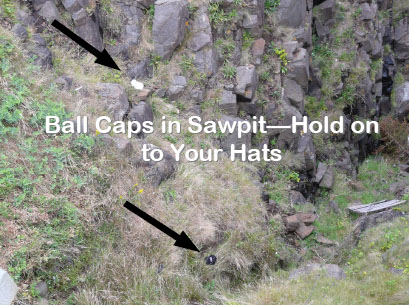
  • The wind is always stronger on the peninsula – the loss of several hats in the Sawpit last summer can attest to that.
  • 
  • The trails can be icy in the winter and may not be passable after a heavy snowfall.
  • Footpath after February snow storm and 2.5 hours of shovelling.
  • It is always best to carry out any garbage because items left lying outside can be blown into the ocean. In the summer there is a garbage can in the parking area which is emptied regularly. 
  • To respect others and for the safety of your pet, it is always best to have dogs on a leash. Not everyone picks up after their dogs which makes it unpleasant for others using the trails, particularly when it is left in the middle of the footpath.
  • Caution sign at stairs.
  • There are a few sharp drop offs and if you venture beyond the marked paths, you should be aware of this and take necessary precautions. It is a long walk back with an injury.
We hope that everyone enjoys the information and the panels help answer some frequently asked questions.

Part of a double rainbow that formed in October 2012


Saturday, November 24, 2012

1958 Compared to 2012

The present keepers house was built in 1958 by Joseph McDowell & Son, a local contractor. Fortunately, Elmer Wilcox documented the construction and took this photograph when the keepers house was finished and the original keepers house was still standing. The photograph was taken from the top of the light house.


Original and new keepers houses taken from the lighthouse in 1958.  Photograph taken by Elmer Wilcox
The original keepers house and small outbuildings were torn down and the site levelled. The keepers house did have an ell on it early on but it was removed probably because of wind damage and other difficulties in keeping buildings tight. leading to its deterioration. Soil remediation for lead and bismuth removed much of the soil where the original house was located and left the site more uneven. Some of the brick and concrete foundations still exist but otherwise it is only in photographs and people’s memories, but as you can see little else has changed with the building footprint, other than decks and paths. The door in the north porch (right side of the photograph) was changed soon after the keepers house was built because of the difficulty of opening it during north east gales.

Keepers House and Boat House as seen from the lighthouse in September 2012.  Photograph taken by Ken Ingersoll.
While some new trees have sprouted, the small clump in the background doesn’t look like it has changed in 52 years.  The herring weir has been moved further away from the peninsula and, of course, the fog bell now sits by the keepers house instead of the lighthouse.

Monday, December 20, 2010

Progress at Swallowtail

A lot has been happening at the keepers house and boat house since the early fall.  The buildings are being restored thanks to funding from the provincial government and local fund raising.

The boat house was badly in need of repair because of the southern wall that was largely non-existent but that has now been rebuilt with the last shingles installed. The red doors have been a topic of discussion from those who have looked up from the ferry or from further down the island. We have windows to repair or have built, including some structural work under the western window, a chimney and wood stove to install and a few other small jobs.  The boat house has been completely rewired, a new ramp and hand rail built and new support posts and skirting installed. 


Joe Ingersoll shingling boat house

The keepers house, while on the exterior has been looking much better, has actually been taking a great deal of time.  The major problem has been trying to solve the water leaks.  In a climate where water can be driven up and into buildings, finding areas where the water is entering can be daunting. 

Joe and Ken building boat house ramp >

The wall paper that was put up for the bed and breakfast has been removed, exposing original paint colours, sometimes vibrant colours that were mixed by one of the keepers, Grimmer Ingersoll.  The original footprint for the house is slowly emerging with the removal of partitions installed for the bed and breakfast.  The old windows are getting a facelift with new glazing and glass where needed.  Storm windows will be manufactured in the new year.  Only six original storm windows still exist and these will be copied.  The original front door has been returned after being stored in the boat house.  Doors that are missing from the kitchen cupboards have been built and chrome hardware purchased where it was missing.  Milk glass globes for some of the ceiling light fixtures were purchased at the Habitat ReStore.  While not the same shape, the style matches the era when the keepers house was built. Most wiring issues have been dealt with but some still exist.  It has been a real challenge to keep new shingles on the roof, despite heroic efforts.  The wind shear can be tremendous.


The wind decided that part of the railing on the deck built on the front of the keepers house was not required and the eastern section was "deconstructed", literally blown apart.  It created an entirely different feeling for the deck and with a little work now allows access to the light house rather than having to walk back off the deck and around the house.  While much larger than the original doorstep, the focus is now closer to the original intent with direct access from the keepers house to the light house.


Southern sun porch with original door re-installed.

A big thank you has to be extended to Laurel Hinsdale, daughter of Grimmer Ingersoll, for lending some photographs of the interior of the house taken in the 1960s.  Little details such as the kitchen counter top or ceiling light fixtures have been determined, including a picture of an old cook stove that was in one of the kitchens of the duplex.  A similar stove was purchased from at a local business and will be installed once the kitchen is ready for it.

Because of the long distance to carry material or tools or remove refuse, creativity has been required at times.  Whether walking out or back, seldom are hands empty.  A well stocked tool kit is also emerging so the tool that you need isn't up the 54 steps.

It has been a treat spending so much time at Swallowtail.  Weather conditions are always more extreme but the marine vista is marvellous.  Whales, seals and seabirds are often seen and sometimes land birds such as Bohemian waxwings, gyrfalcon, peregrine falcon, bald eagles and others passing through.  White-tailed deer are often seen on Lighthouse Road.  Snow in the last week or so has changed the landscape and unlike most years, the snow has lingered.
Ken carrying pine along the path from the top of the hill.