Showing posts with label lighthouse. Show all posts

Saturday, March 29, 2014

Challenges of Saving Lighthouses

Lighthouses are usually located in the face of storms, exposed on several sides to strong winds and sea spray, frequently difficult to get to and challenging to maintain.  With lighthouses de-staffed or de-commissioned, budget cuts rampant, and maintenance minimal, it is hard to see these once well-maintained structures deteriorate to a point that they begin to crumble but it is becoming all too common.  The magnitude of the maintenance or restoration, and the ability to get to the lighthouse is often overwhelming. We have been fortunate with Swallow Tail that ownership has been transferred, access is challenging but better than many, and through the support of the community and access to various sources of funding, restoration work has been possible. 

Unfortunately, in five months, three other lighthouses in the Maritimes have disappeared.  Two collapsed during storms, the abandoned Fish Fluke Point on Ross Island decommissioned in 1963 but defied gravity for years (November), and Church Point on St. Mary’s Bay, NS, decommissioned in 1984 (March), and one burned to the ground, the remote fibreglass lighthouse at Point Aconi on Cape Breton Island (February).  Fire was always a worry before lights were electrified.  Elodie Foster, one of the light keepers at Swallow Tail, died from her injuries after her clothes caught fire while trying to start the burner for the light.  More recently, electrical issues may be the cause of some fires because of the heavy salt presence and corrosion of electrical connections. Two electrical issues at Swallow Tail threatened to cause fires last fall and had no one been working in the lighthouse, the problems would have gone unnoticed until it was too late.  Vandalism has also been a cause of some fires and has plagued locations such as Partridge Island in Saint John, and may have been the cause of the grass fire at Swallow Tail in April, 2007, which threatened the lighthouse and keepers house.  It has prompted some communities to install security cameras.   The ones at Swallow Tail can be viewed on the Village of Grand Manan website (www.villageofgrandmanan.com).

Fish Fluke Point lighthouse in better days.  (unknown origin of photo)
Collapsed Fish Fluke Point lighthouse as seen from the air in November 2013.
Church Point lighthouse before collapse. (from CBC.ca)


Church Point lighthouse after collapse, 27 March 2014. (from CBC.ca)
Point Aconi lighthouse before it and the building beside it, burned to the ground in February, 2014. (from Cape Breton Post)

Collapse was not thought to be an issue at Swallow Tail but once work began last fall, it became apparent that it could have been possible.  The lime had eroded out of the mortar, making the mortar crumble.  The stone foundation was slowly pancaking, with the stones being pushed outward.  The eight guy wires and the massive concrete floor in the equipment room were the only things holding the tower upright with probably only five large stones in the foundation carrying weight.  Had any of the guy wires failed, the tower would have begun listing or worse.  To fix this, all the stones were removed, one side at a time, and then returned with new mortar between the joints. The large corner stones, too heavy to easily lift, were adjusted back into place.  The foundation is now functional again and should last for many more years with minimal maintenance.


Peter Devine rebuilding stone foundation at Swallow Tail, September 2013.
During this process, it was discovered that the large wooden beam under the front door had completely rotted away.  The remains of the beam were removed using a dust pan.  Instead of trying to fit a new wooden beam back in a very tight space between the large immovable concrete step, stone foundation and the floor joists, a concrete beam was constructed.  One of the 1859 wooden pegs, used to hold the heavy timber structure together, was discovered in the crawl space during the work, looking the same as the day it was made.  This was the only spot were the heavy timbers of the lighthouse had completely rotted.


Rotted timber beam under front entrance, September 2013
New concrete beam to replace rotted timber, September 2013.
 
Salt corrosion is another challenge, rusting nails so they no longer do their job.  When some shingles were removed on the northern side of the bell house, the boards underneath came off as well.  This was also an earlier problem with the boathouse and the entire southern wall began to fall off in large pieces as the nails disappeared and that wall had to be rebuilt.  The shingles were stripped off the bellhouse, the boards renailed, and new shingles returned.  Shingles on some sides of the tower were also falling out because the nails were gone.  Face nailing to hold them in place during previous work only complicated the problem with water getting behind the shingles and rotting the wood.  Several places on the tower, notably where the windows had been boarded up, were in worse shape than the rest of the lighthouse, even though the boards were only 40 years old compared to over 150.  As the rot continued, longer nails were used to hold the shingles which further exacerbated the problem.  It was very noticeable while scraping the sides where the problems were located because of the sponginess.  Replacing the rotted wood and shingles where required, caulking the nail heads, plus one to two coats of primer and two coats of finish paint will prevent this for a few years. Because of the extreme weather conditions experienced on the point we hope in the future only the paint will suffer and not the wood behind.


Northern wall of the bell house.  The nails had rusted off and the boards had to be nailed back in place before the shingles could be attached. 
 
Areas on the lighthouse that needed repair because of water penetration causing rot.  The area around the fog horn was because of caulking and flashing failures.  The upper area on the tower was probably because of face nailing shingles allowing water to penetrate.
 

Custom blade on paint scraper.
The entire lighthouse and bell house were scraped, primed and received two coats of paint.  The new shingles were primed twice.
 
Removing the windows in the tower in the 1970s was actually beneficial in many respects since there was little maintenance after the lighthouse was destaffed, but it changed the interior with no natural light or ventilation.  Having the opportunity to return the windows to the original locations in the lighthouse was a goal during the restoration but a challenge since everything had to be built from scratch.  One window could not be returned because the current fog equipment is located in that spot on the first floor.  Windows from an 1849 house in Ontario were donated by the owners, who had once worked at a lighthouse in British Columbia.  They were honoured to have them reused at Swallow Tail.  The storms and gablets (or dormers) were new construction from mahogany with copper flashing and sills in an attempt to resist the harsh climate.  The interior has been completely changed with the additional of natural light and makes it a very pleasant inside.


Reglazing 1849 windows donated for the lighthouse.  The bottoms had to be cut down to 8 from 12 panes.  New glass was installed in each window.
Window unit - gablet with storm, all new construction

Windows restored on the southern side of the lighthouse.
 
The harsh winter weather stopped work in mid-December at the lighthouse.  Work will begin again sometime in April.  The windows and interior will be completed including repairing the lathe and plaster and painting, the boardwalk from the keepers house (cabled in place to protect it from the strong winds) will be built, and museum displays installed.  We are hoping to have the lighthouse open again this summer.  Restoration work could not have been possible without the financial assistance of the Atlantic Canada Opportunities Agency, Regional Development Corporation, New Brunswick Built Heritage, Village of Grand Manan, Grand Manan Rotary Club, and generous donations.

Thursday, March 27, 2014

2014 Sea Ice Storm

A spring blizzard  moved through quickly March 26, leaving behind sunny skies, either bare ground or snow banks and sea ice on exposed coasts after storm to hurricane force winds.  As in February 2013, Swallow Tail took the brunt of the storm but the quick movement of the storm resulted in some sea ice frozen across the peninsula but not nearly as thick as in 2013. 

Power was out on the point for 24 hours after the salt spray tripped a breaker on the pole (over 36 hours in 2013).  Two of four webcams no longer work after the wind, salt spray and power outages took their toll.  The antenna for the WiFi for the ferry blew off the boathouse, laden down with ice.  The poor flag that was flown for the first time only two weeks ago is now a tattered shred, despite reinforcing the outer edge.

Here are some photos:

Ice covered northern side of the boat house.

WiFi antenna blown off the boathouse, covered in ice.

Thickness of ice on lighthouse.

Frozen sea ice on bell house attached to lighthouse.  Ice froze horizontally as the spray was blown across the building wall.  Taken by Sarah McDonald.
Ice covered railings leading to bronze fog bell.

Ice covered rope safety lines along foot path.

Ice and snow on bronze fog bell.

Ice covered wooden bench facing away from freezing  salt spray.

Ice covered wooden bench facing freezing salt spray.

Ice covered fog horn.

North side, roof and chimmeys of keepers house covered in ice.  A couple of shingles lifted on the roof replaced in 2011.

Swallow Tail peninsula covered in sea ice.

Ice covered iron eye ring and vegetation.

Icy sign post with Sarah taking photos from below.

Photo taken by Sarah McDonald of sign post.
Frozen sea ice on the railings for the steps.

Ice covered trees near the Sawpit.  No wonder they don't grow branches facing the water.

Windows in the keepers house covered in ice on the outside.

Tattered flag after flying for only two weeks.

Web cameras on Welcome Centre - only two still are working after wind and power outages.

Sunday, April 21, 2013

Fancy Hat Tea - April 20, 2013

The fourth annual Swallow Tail Tea took place April 20 at the Covert Hall in North Head, Grand Manan Island.  The Inn at Whale Cove Cottages organized the food and staffed the tea.
Inn at Whale Cove Cottage owner, Laura Buckley, and her staff organized the food and  worked the tea.    Many volunteers are needed to run one of these events and their efforts are greatly appreciated.
The food, as usual was its normal high standard, wonderful, with a full buffet of sandwiches and sweets.  The weather was probably to our advantage with rain and wind in the morning which prevented many outdoor activities.  Over 70 people attended ranging in age from not quite two to 99.  As usual, takeout was also available.
Part of the Buffet Table with Swallow Tail artwork and photographs

Long view of the Buffet Table in the Covert Hall with sweets and sandwiches.

Part of the Buffet Table with Swallow Tail artwork and photographs

Many thanks to everyone who advertised the event, set up the hall, donated food, worked the tea, and helped with the cleanup.  Sandra Ingersoll won the dinner for two at Inn at Whale Cove Cottages, an annual draw that is part of the cost of the tea. We also sold our first raffle tickets on "Fog Bound" the beautiful Tidal Threads quilt that is nearing completion. These will be available all summer and through the fall.  The draw will be at the Christmas Market.


The money raised will go directly to the restoration of the Swallow Tail lighthouse, the scale of which will vary this year depending on the success or failure of grants to fund the project.  We are hopeful that we will be able to get the majority of the work done.
Many repairs are necessary in the lighthouse including repairing plaster from water damage.  Water is leaking in the tower from the lantern.
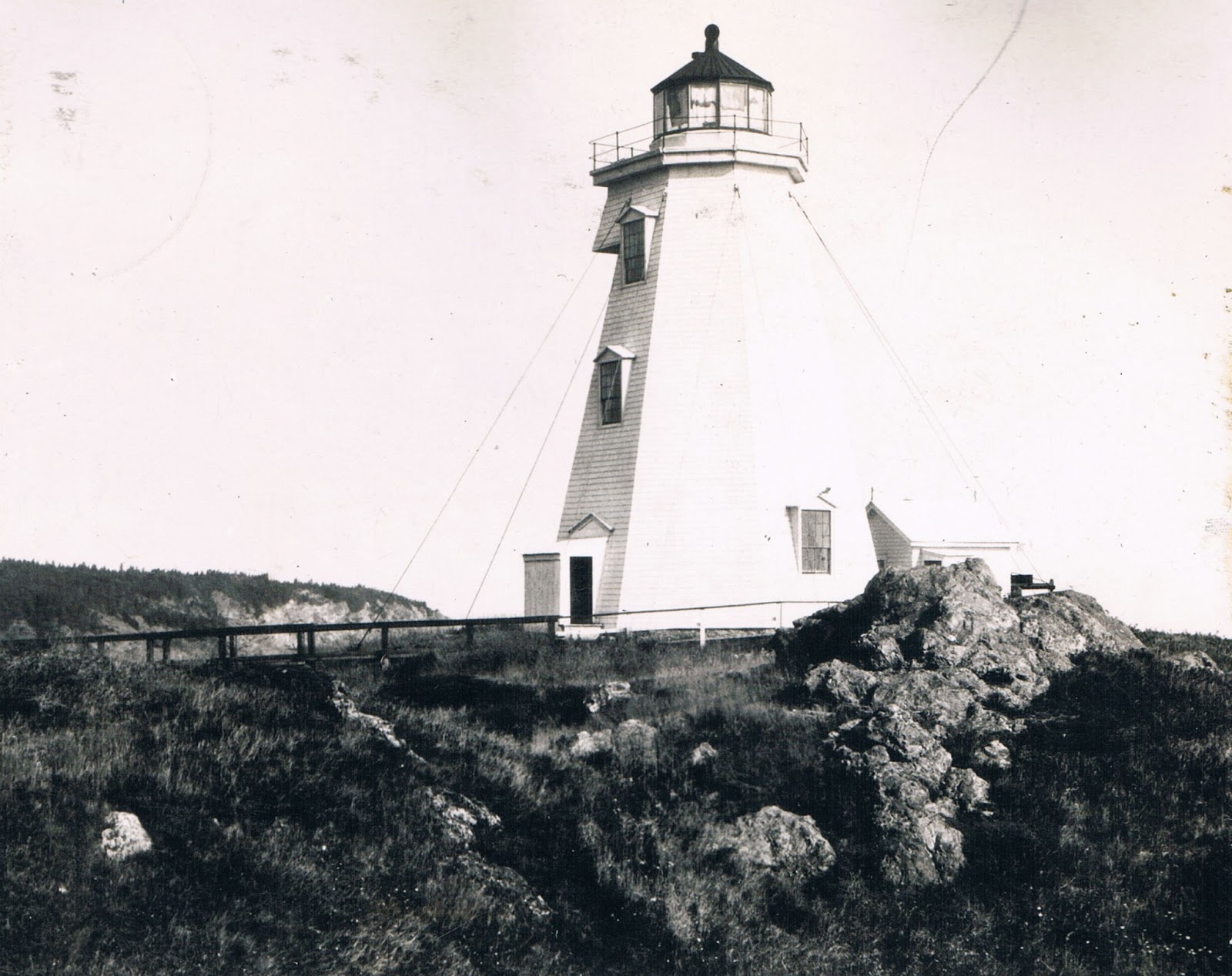
Photograph of the Swallow Tail lighthouse from 1932.  The plan is to return two windows above the door  of the tower as well as a third window on the other side.  The lower window can not be returned because of the fog equipment now located there.


Tuesday, April 2, 2013

Freezing Spray Warning - 1952

I was forwarded from Canadian Coast Guard files, a photo of the bronze fog bell, bell house and lighthouse at Swallow Tail covered in thick ice from a storm in 1952.  Looks much like the photos we took in February 2013 but instead of the fog bell, the fog horn was completely iced in!  Nothing like a muffler of ice.
Icy rime covering fog bell in February 1952 - Canadian Coast Guard photo.

Monday, February 11, 2013

Freezing Spray Warning - Blizzard 2013

If you live along a coast or are a boater you are probably familiar with the weather term - freezing spray - which is usually associated with vessels.  When the air temperature is cold and water hits vessels because of the spray from waves, the water freezing on the vessel and can built up to an extent that it can compromise the stability of the vessel.  The warnings are real and if the conditions continue for any length of time, a substantial amount of ice can accumulate. But you may not have thought about the effects it can have on land when high winds and waves combine to carry the ocean spray onto land.  The same ice build up can occur but is usually one sided depending on the direction of the wind.

On February 9 two major storms combined into one, as one storm moved in from the west and the other up the eastern seaboard, culminating in a storm with hurricane characteristics.  The sustained winds and high tides caused much havoc on Grand Manan, shredding tarps at a construction site, destroying a hangar at the airport, raising water levels beyond the normal high tide, bringing drift wood and rocks up onto land, breaking trees limbs and toppling trees, wreaking havoc with the power lines, and leaving places in the face of the nor'easter, like Swallow Tail, coated in frozen salty brine and looking more like the aftermath of an ice storm, rather than a snow storm.

The following photos were taken the next two days, when the weather had cleared to bright sunshine and calmer seas.

John's bench overlooking the Swallow Tail peninsula

Railing on the deck at the Welcome Centre overlooking the Swallow Tail peninsula

Frozen Swallow Tail peninsula.  Freezing spray coated everything from the north and east, bending trees with the weight of the ice.
Frozen, salty stairs and railings.
Bent tree covered in salty ice at the head of the stairs

Ice coating the railing on the foot bridge.

Ice almost completely covering the railing on the foot bridge on the northern side.

Frozen spray on the safety railing at the head of the stairs.  The railing is red.

Frozen spin drift in the Sawpit.

Looking down into the Sawpit, filled with frozen spary and styrofoam from a floating weir that is breaking up from the extreme wave action.

Frozen spray on the mafic dike of the Sawpit.

Trees bending under the weight of the freezing spray.
Trees covered in freezing spray along the foot path.

Frozen bench, trees and trail.

Balls of frozen spray and an ice coated bench.

Fog bell deck covered in ice.

Layers of ice coating the rope hand rail along the foot path.

Heavily weighted rope rail and ice balls created by freezing spray that completely crossed the Swallow Tail peninsula from one side to the other.

Where did the windows go?  Ice covered north side of the keepers house.

Ice covered eastern side of the keepers house.  Note the difference with the southern, almost ice freeze, side.

Ice covered eastern side of the keepers house and deck.
Ice covered rocks and vegetation.

Ice covered slope from freezing spray.

Can you find the tree under the ice?

Heavily ice-coated  spruce trees.

Don't believe the ice is from sea spray?  Seaweed frozen into the ice near the lighthouse.

Fog horn muffled by a thick coating of ice.

Bell house and lighthouse covered in icy rime.  The spray from the waves extended more than halfway up the tower.  A snow plow driver looking down at the lighthouse during the storm said that the tower completely disappeared from view several times as the waves and spray crashed over the point.  

New version of the wooden lobster-trap bench - ice bench!  Good thing the bench is bolted to the rocks or it probably would have ended up elsewhere.
 It is difficult to gauge the amount of snow that fell.  The wind created huge snowbanks or completely moved the snow elsewhere, leaving bare ground.  Many on the island who experienced the Groundhog Gale in 1976 commented that this storm had the same ferocity with sustained high winds for two days, combined with extremely high tides and storm surge.