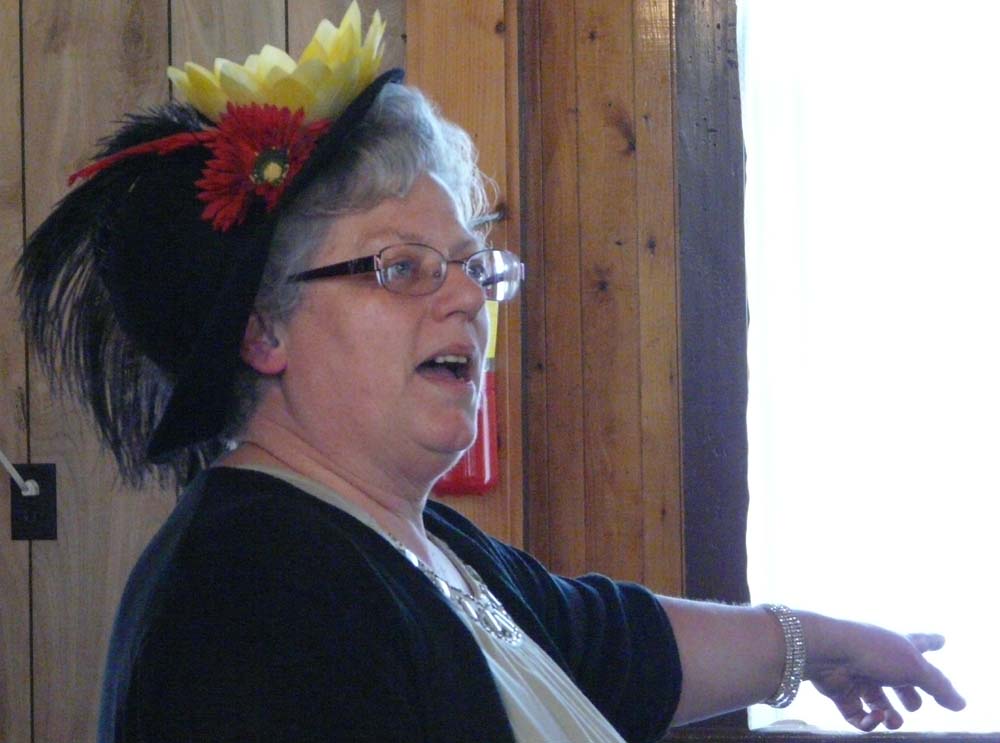
Showing posts with label Grand Manan. Show all posts

Sunday, July 22, 2012

Lobster Roll Supper - Fund Raiser

We had yet another wonderful fund raiser for the Swallow Tail light station on July 7, 2012 at the Grand Manan Curling Club. 

The list of volunteers and in-kind donations is lengthy to have such a wonderful success, including the three lobster fishermen who donated the lobster (Deane Griffin, Glenn Foster and anonymous), Laura Buckley and her crew from the Inn at Whale Cove Cottages for arranging, preparing and serving the food, Ce Bowdoin (tea biscuits), Swallowtail Lightkeeper Society volunteers for setting up, serving, working the door, and cleaning up (Ken Ingersoll, Sue Stymest, Theresa Noel, John Pattison, Linda L'Aventure, Pam Charters, Alexis Phillips, Sue McCulley, Lloyd MacFarland), musicians (Before the Mast, Dinah Romig, John McDonald, Alexandre Banks), Rick Doucet (serving), Atlantic Save Easy (rolls), Walter Wilson (salad), Strawberries, cream and other miscellaneous (Marathon Inn, Pettes Cove Arts, Peter and Marilyn Cronk, North Head Bakery McLaughlin Inn, Holly and Kirk Cheney, Deb Tremblay, Island Art workshops), , Adventure High (door prize).  We want to thank the Grand Manan Curling Club for the facility (hall rental and cash bar).  The Grand Manan Museum also provided their projector, on short notice, for the continuous slide show of the progress made at the light station since 2008.  None of this could have happened without the support of the community and visitors who joined us for this fun evening.  Thanks so much.

Great crowd enjoying the lobster rolls and the music
Inn at Whale Cove Cottage crew (Megan, Janna, Annie, Emmy) and Alexis Phillips preparing lobster rolls
Honourable Rick Doucet, MLA, helping serve
Before the Mast preforming one of the many songs during the evening.  Rolling Down is the title song from their new CD (http://www.beforethemastseashanties.com/)

July 7, Flag Raising and Bell Ringing

With spectacular weather, a group of nearly 100 people walked out to the keepers house at Swallow Tail on July 7th, the 152nd anniversary of the light house first being lit.  Two RCMP officers were present, along with the Honourable Rick Doucet, the MLA for the area and Kirk Cheney representing the Village of Grand Manan who have been very supportive of the restoration efforts at the Swallow Tail light station and are in the process of reconsolidating the light station with the acquisition of the light tower in the near future. 


RCMP officers breaking flag at annual flag raising
 After a brief welcoming, Wayne Clifford, John Peacock, MJ Edwards, Millie and Alexandre Banks played an impromptu piece on the bronze fog bell, returned to the property in November 2011.  The new deck around the bell acted as a natural stage for the event.  Members of Before the Mast (http://www.beforethemastseashanties.com/) continued with two songs before everyone was given a chance to play the bell if they wished.

The Lahey Family was represented to commemorate the 100th anniversary of the beginning of 22 years of service by George Lahey as light keeper .  The Dalzell family regrettably could not make the event which also marked the 100th anniversary of the retiring of George Dalzell as light keeper after 19 years of service.
Before the Mast helping celebrate the Swallow Tail light station anniversary
The descendants of the late light keeper, George Lahey, ringing the fog bell
Despite damage from many years of use and also being moved several times, the bell sounded wonderful and could be heard beyond the peninsula.  Listen to three different strikes of the bell here: http://www.freesound.org/people/bob.burgess/sounds/160882/

Wednesday, November 30, 2011

Fog Bell Has Landed

As part of a grant from the Legacy Fund of Heritage Canada, celebrating the 150th Anniversary of Swallowtail Lighthouse, we have been renovating the trails and preparing a tribute to the lightkeepers.  Part of this includes returning the bronze fog bell that was used for many years to alert mariners in times of restricted visibility.  With the propensity of fog in the Bay of Fundy, many months of the year, fog alarms were as important as the light.

Bell house prior to 1922 at the extreme easten end of the peninsula. 
The photo was posted to the Facebook group - Old Grand Manan Photos
Reference to the fog bell begins in 1915 when a building was built at the extreme end of the Swallow Tail peninsula, although the date on the bell is 1904.  In 1922, the bell was moved to sit beside the lighthouse to make it easier for the light keepers to keep the winding mechanism operating which in turn rang the bell.  Originally, fog bells, horns, guns were only sounded in response to a fog horn or bell from a passing vessel but with the development of an automated system, similar to what is used with spring wound clocks, the fog bell could be sounded throughout inclement weather that restricted visibility.


Close-up of bell house on northern side of lighthouse.  Elmer Wilcox photo, 1958.

Bell house and fog bell on northern side of Swallowtail light house.  Elmer Wilcox photo, 1958
Both the bell and the bell house were moved to the northern side of the lighthouse where the bell sat until 1980.  A fog horn had replaced the fog bell at an earlier time. The bell had developed a small crack where it was continuously rung and the tone of the bell had changed. The lightkeeper at the time, Grimmer Ingersoll, organized the removal of the bell from the point to the Grand Manan Museum where it sat in front of the Deep Cove School House.  Moving the bronze bell was not an easy feat.  At 900 kg (2000 lbs), it took brute force and lots of ingenuity to accomplish the task.  Unfortunately, the bell did suffer some damage when it was moved in 1980 and two chips can be found on the edge of the bell where chains were wrapped around it.
Light keeper, Grimmer Ingersoll, and friends moving bell in 1980,
eventually getting it to the Grand Manan Museum
When the Swallowtail Keepers Society was formed in 2008, the Museum agreed to donate the bell back to Swallowtail.  A large deck was built by Terry Davidson, George Best and Ken Ingersoll, over the concrete base of the old flag pole and a stand was attached to hold the bell.  Repairs had to be made to the top of the bell and modified to include an eye and shackle for lifting. Michael Brown of Waterfront Fabricating drilled through 6.5 inches of steel at the top of the bell to install two new plates and an eye.  The bell originally had two bolts that held the bell on an I-beam but these were not appropriate if the bell was to be lifted and then lowered onto the stand. The bell could have been strung in a cargo net but that complicated the moving process and recovering the cargo net afterwards, given the weight of the bell.
Terry Davidson and George Best beginning the bell deck

Finished bell deck awaiting the bell
Once the bell was ready to be moved, Randy Brownlee and the M.G. Fisheries boom truck picked up the bell and drove it to the top of the hill at Swallowtail, leaving only 300 m (1000') to move the bell but with 54 steps, a wooden foot bridge, a gravel path over undulating terrain, and a flight of stairs up to the deck, that was not an easy feat.
M.G. Fisheries boom truck that moved the bell from the Grand Manan Museum
 to the top of the stairs leading to Swallowtail.  Randy Brownlee photo.
Inquiries went out to the Canadian Coast Guard and a military base to see if they might be able to use one of their helicopters to move the bell.  No promises were made but it was suggested that if everything was in place, if a helicopter was available, it might happen.  In the middle of November, the Canadian Coast Guard needed their heavy lift helicopter to move building material to Partridge Island in Saint John, NB to construct a new helicopter pad.  Since that is only 25 minutes by helicopter, we were asked to be ready on short notice.  A call at 8:30 on November 21 set the final process in motion.  The helicopter would arrive at 1:30 to move the bell.  This in part was to take advantage of the decreasing wind in the afternoon and to allow myself to be present since I was booked to make a right whale aerial survey the next day with the Fisheries and Oceans Canada as part of the Lobster Mitigation program for Lobster Districts 36, 37 and 38.  locations of right whales are provided to lobster fishermen to help them avoid conflicts with right whales and their fishing gear.

Calls were made to a few people to pass the word about this special event.  Over a dozen people watched as the helicopter arrived to survey the pick up location and the bell deck.  Because of the weight of the bell, only the pilot and one crew member was aboard to do the lifting.  One person was at the bell to hook up the cable and two were at the bell deck to position the moving bell onto the stand.
Jamie McCavour grabbing hook from Canadian Coast Guard helicopter

Jamie McCavour, Canadian Coast Guard,  hooking up cable to bell before lifting
With great anticipation and a bit of trepidation hoping that nothing would happen and the bell wouldn't be lost into the ocean, the helicopter moved into position.  The bell slowly rose off the wooden pallet where it had been sitting.  The pilot then took a long wide circle to approach the bell stand from the south, just as the Grand Manan Adventure ferry rounded Swallowtail.  After a few false approaches, the bell finally was positioned accordingly and was quickly unhooked from the helicopter.  A cheer went up from the onlookers.
The Grand Manan ferry, Grand Manan Advenutre going around Swallowtail as bell
was being brought in a wide arc to the bell deck.  Note the bell house is attached to the lighthouse.

Bronze fog bell lifting into air.  Martha Eaton photo.

Canadian Coast Guard helicopter taking bronze fog bell to the bell deck in a wide arc.

Steve Lloyd and Bob Hebert (Canadian Coast Guard) coordinating the landing of the fog bell on the stand

Bob Hebert (Canadian Coast Guard) unhooking the cable on the fog bell once it was positioned on the stand.


Here are two videos taken of the move
(pick up of the bell from the top of the hill by the Coast Guard helicopter).

I walked down to the see the bell in position and had a great sense of accomplishment as I came over the rise and saw the bell.  While the bell is slightly off centre, that can be fixed.  I took great pleasure in ringing the bell for the first time since it had been removed from Swallowtail.  The tone echoed nicely and while I don't have perfect pitch, the tone is supposed to be an F, according to the manufacturer, Meneely Bell Company of West Troy, NY.

Canadian Coast Guard crew - Bob Hebert, Jamie McCavour, Paul Mosher (pilot) and Steve Lloyd


Saturday, July 30, 2011

Chimneys Getting Repaired

Joe and Ken wrapping the chimney with plastic
for the winter to stop some of the water from getting in
and protecting the chimney from further damage
Brian McLanahan is staying at the keepers house this week and will be repairing the chimneys.  The chimneys are in great need of repair and the leaking flashing has been the cause of much of the water damage in the house.  It will be great to have them functional again and the two stoves moved out to the house.

While waiting for the Rotary Festival fireworks tonight, we could see the lights on in the house.

Sunday, July 24, 2011

Boathouse Gifts

If you haven't been to Swallowtail lately, there are some new additions.  We have two summer students, Geoffrey Hadaway and Robyn Guptill.  They are keeping the building at the top of the hill open daily, the former boat house from the decommissioned Ross Island light house, Fish Fluke Point.  They are greeting visitors and selling a few items to help raise funds to maintain the property, pay the utilities, etc.

 The t-shirts have the same design as the very popular cotton tote bags sold last year for the 150th anniversary.  They are available in four adult sizes and several children's sizes.  There are also matted photographs, notecards, postcards, bookmarks, jars of beach treasures and some used books for sale.

We also have two picnic tables loaned to us from the Anchorage Provincial Park.  One is on the deck and the other is near the stairs.  We do have water for sale and you can bring your picnic lunch and enjoy the view.

Come visit!

Wednesday, July 13, 2011

Flag Raising and Memorial Service 2011

July 7, 2011, saw another gathering of those keenly interested in the Swallowtail Lighstation.  The flag was raised for the first time this year with an RCMP officer in attendance as O Canada was sung.  A plaque was also unveiled to commemorate the sacrifice of Elodie Ingalls Foster in her role as a lightkeeper in 1936.  Family members were in attendance to unveil the plaque that was later installed on the lighthouse where a terrible accident resulted in her clothes catching fire in the evening of August 7.  Despite medical care, she died the next day. 


 Text on the plaque reads:

In Memory Of

Elodie Ingalls Foster

19 February 1892 - 8 August 1936

In the early evening of August 7, 1936, Elodie Ingalls Foster in her capacity as second keeper at Swallowtail attempted to light the lamp in the lighthouse tower. She had carried out these duties previously and for unknown reasons the flammable liquid used soon engulfed her in flames. She was able to get out of the tower and reached the living quarters of Swallowtail. She was quickly found by family members and medical attention was called. Despite their best efforts Mrs. Foster died from her injuries the following day.

The death notice in 1936 read:

Swallow Tail Light


Mrs. Thos. Foster, Wife of Lightkeeper, Suffers Fatal Injuries in Performance of Duties As Second Keeper

ALONE AT TIME OF ACCIDENT

North Head, Aug. 10 – (Special) – Death came to Mrs. Thomas Foster late Saturday afternoon as the result of severe burns received while lighting the lamp at the Swallow Tail Lighthouse here. Friday evening directly following the accident it had been hoped and believed that she might survive but as the hours passed medical advice saw that the end was only a matter of a short time.

As second keeper of the light and alone at the time with the exception of her three-year-old granddaughter, Wilhelmina Knyff, Mrs. Foster had taken her young company to the light tower. She adjusted the lamp parts and applied wood alcohol with a torch and somehow, not thoroughly understood, the second application spilled the inflammable liquid which quickly spread, catching her clothing. In a moment she was a mass of flames and tearing at her clothes to rid her body of the fire, raced down the long winding flights of stairs to the living quarters of the light.

The terrified little girl left in the light started from the tower which was now afire and fell down the deep stairs. She was injured slightly about the head.

Just at that time Mrs. Foster’s two daughters, Miss Ruth and Mrs. Eddy Knyff, her son, Leonard, and Junior Ingersoll, a companion, rushed in. Horror stricken with what they found Len had presence of mind enough to immediately seek medical attention and his father at Southern Head Light, and to extinguish the fire in the tower.

Suffering intense pain, Mrs. Foster was conscious at times, relating as nearly as could be, what had happened. A greater part of her body had been seared by flames and on through the night and during Saturday her condition changed but little with the exception of a general weakening. Just a few hours before “lighting time” the end came.

Mrs. Foster was born at Ingalls’ Head, the daughter of the late Capt. and Mrs. Loran Ingalls and when her husband took over the appointment as keeper at the Southern Head Light, entered zealously into the work with him. She was considered as able and efficient second keeper in her own right and when changes in appointments came and they transferred to Swallow Tail she was made assistant keeper until Mr. Foster would be enabled to leave the light at Southern Head when that would be taken over by his successor. Their son, Leonard, has been acting as keeper at Swallow Tail.

The suddenness and painful conditions of her demise came as a shock to the entire island, to her family and immediate friends. She leaves to mourn her husband, Thomas H. Foster, one son, Leonard, two daughters, Ruth, at home, and Mrs. Eddy Knyff of Eastport, one brother, Paige Ingalls, of Black’s Harbour and Ingalls’ Head.

Tuesday, May 10, 2011

Four years after the almost tragic grass fire at Swallowtail.

April 1, 2007 fire as seen from my deck.
The April 1, 2007 grass fire at Swallowtail almost saw the buildings (light tower and keepers house) burned to the ground if it had not been for the fast action of the Grand Manan Volunteer Fire Department.  Their hoses just reached the keepers house but to protect the lighthouse itself, they set back fires and used sheets of plywood to keep these fires from getting out of control.  The creeping juniper burned very hotly and were just ashes afterwards.  None of the tamarcks survived.  Here is a link to some pictures taken that day that I found recently while looking for other information about Swallowtail: http://travel.webshots.com/album/558569230dFBKQw

Sunday, May 1, 2011

Royal Tea a Success

The day began with a spattering of rain but it didn't damper spirits of those attending the Royal Wedding Tea. Approximately 65 came to the tea bedecked in their finery. Laura Buckley and her crew outdid themselves as usual with enough sweets and sandwiches to feed three times the people.
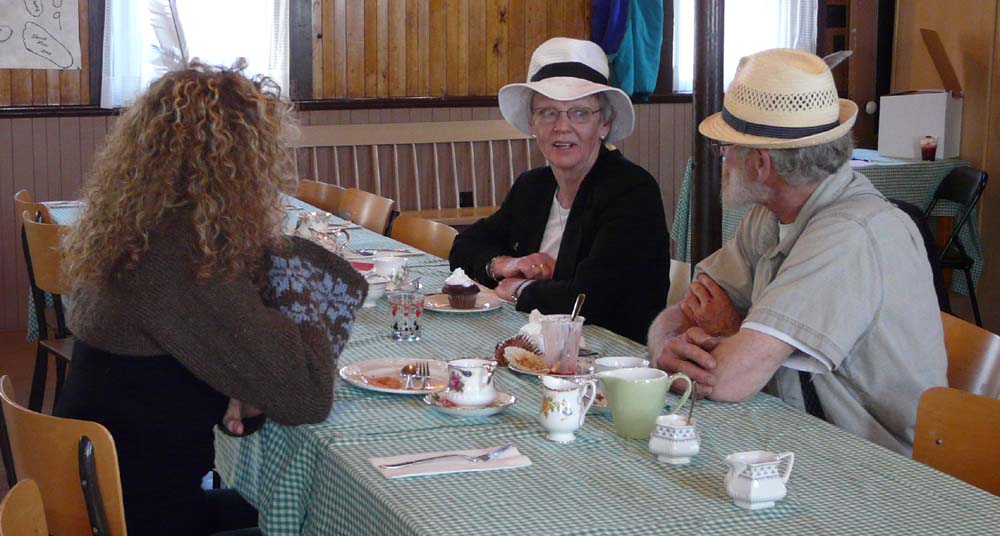
Portions of the Royal Wedding were played throughout the tea on a wide screen TV and while we had countesses, duchess and ladies, not many counts, dukes or lords made an appearance but those that did certainly enjoyed themselves.

The hats came in all shapes, sizes and colours and while flowers dominated, butterflies, fish, dories and resplendent fabrics made appearances. But it didn't stop with hats, fancy dresses, shoes and gloves also finished the look.

Take away packages were available and several containers of cupcakes were taken to the Grand Manan Nursing Home after the tea.


Anticipating the Royal Tea.  Tables and television set up.

Laura Buckley coordinating the layout of the buffet with
Jana, Emmy, Megan and Harley
Whale Cove Cottage crew: Laura, Megan, Jana, Emmy and Harley
Buffet layout.


Some of the people attending the tea in Covert Hall.


Hats came in all shapes, sizes and colours -
Dawn, Janie, Elaine and Ginny.

Laura, Hallie and Bessie

Mary and Sandra

Evelyn, Kaye and James

Megan, Sidney, Taylor, Annie, Harley, Haven

Emmy

During the tea with the Royal Wedding  playing in the background

Laura

Cleaning up after the tea.

Everyone went away feeling they had a wonderful afternoon and we were able to raise some money to continue the restoration work at Swallowtail.  Many thanks to Laura Buckley, Emmy, Jana and Megan Greenlaw, Harley Bass, Diane Jaillet, Fredonna Dean, Marilyn Cronk and Bryant Eaton for serving and/or cleanup;  Ken Ingersoll, Lloyd MacFarland and Bryant Eaton for setting up the tables; Clare Toyer, Cecelia Bowden, Marilyn Cronk, Diane Jaillet, Pam Cronk and Pam Charters for additional cooking. 
Back view of the Countess of Pettes Cove's hat.

Friday, April 15, 2011

Looking for former light keepers at Swallowtail and photos


Colourful sky behind Swallowtail Light at sunset January 3, 2011

We were successful in being awarded a grant from Heritage Canada Legacy Fund in April.  This grant is dedicated to the former lightkeepers at Swallowtail Light on Grand Manan Island and will involve returning the brass fog bell to the peninsula this summer, upgrading the trails, parking and installing a winch for the stairs. 

The one problem we have is a gap in our knowledge of all of the light keepers and assistant light keepers who have worked at Swallowtail Light.  We are also interested in getting copies of any photographs of the former keepers that can be added to the historical display we are developing.

Please let us know if you have anything that might be of help.

Saturday, January 22, 2011

Signature graffiti

During renovations of the keepers house, I have uncovered two signatures on the back of trim, one in the eastern kitchen and one in the eastern bathroom.  The former is from 1996 when renovations were underway to convert the keepers house to a bed and breakfast.  It was on a piece of trim around a pass through window from the kitchen to the dining room (former living room) in a new partition. The carpenter signed his work, not to be exposed again until it was torn off to return the original floor plan.  The latter signature dates from 1958 when the keepers house was being built.  Again it is on the back of window trim in the bathroom that had to be removed to take off the tub surround.

"Larry Small July 19 1996" Signature on trim from a pass through window built in the eastern kitchen in 1996 by Larry Small during renovations for the Swallowtail Inn Bed and Breakfast.

"Swallowtail Light Joe McDowell" Signature on bathroom window trim dating from 1958 during the construction of the keepers house by Joe McDowell company. 

A stencil was discovered in the boat house from the assistant keeper, Addison Naves.  A bit difficult to see in yellow paint, it is on the wall beside the work bench.
Stencil of "A C Naves" found in the boat house.  This dates from the late 1950s.
In both coat closets in the keepers house there is what appears to be the combination for a lock or safe.  I do not know what this was for but it was obviously important to be written on the walls in both sides of the duplex for the keeper and assistant keeper.  Fortuantely neither closet had been painted so the original pencilled numbers remain.

Tour of the light tower at Swallowtail

January 20 was an ordinary day in our renovation of the keepers buildings at Swallowtail until I heard the Coast Guard helicopter.  An inspection of the tower was underway and I grabbed my camera and headed over to the tower.  It isn't often the door unlocked these days and even when it is the tower is still off limits.  However, I was privileged to be able to follow Jamie who is responsible for the light towers in this area on his inspection.  A small sign on the inside door is a reminder of when the tower was open to the public and why it isn't any longer.

Swallowtail Lighthouse with door open

Sign on inside door of the light house
Upon entering the lighthouse, the first floor has been partitioned to house the diesel generator and fog detection equipment.  Until the light house was automated, this floor was unpartitioned.  There is the cage and ladder on the other side which was used to suspend a painter for painting the outside of the tower.  There is a door to the bell house and a set of stairs leading up to the second floor.  Reflecting back on a time when light houses were staffed by keepers and their family, there is a basket ball hoop on the wall wherea pick up game or practice could be done in the comfort of the tower.  The space is now limited but must have been a great place to play for the keepers' children.  There is some indication of water damage on one of the lathe and plaster walls and under the fog detection tubes but otherwise, entering the first floor is like stepping back in time.

Equipment room on first floor with generator and automatic fog detection equipment

Desks on the first floor.  Door to the bell house is in the background

Basket ball hoop on the first floor used by the keepers' children

Ascending the stairs to the second floor, I wanted to lean to one side because the walls slope in.  The second floor is wide open with a central post and lathe and painted plaster walls.  The outlines of the two former windows can be seen in opposite walls where they have been boarded up to protect the tower from water damage.  The windows were large and had 12 panes over 9 panes.  The path to the next set of stairs is painted on the floor.  There had been mercury contamination in the tower but the Coast Guard had remediated the problem by raising the air temperature to over 26.7 C (80 F) to vapourize the mercury in the building.  When the readings dropped to insignificant on meters which sensed mercury, the temperature was dropped back to ambient.  There is still some mercury trapped between the floor boards but there is no safety hazard unless the air temperature inside the tower is above the vapourization point of mercury.  Water damage in the ceiling where the plaster is hanging or has dropped to the floor is the only damage visible.

Looking down to second floor.  Debris is from plaster falling off the ceiling from water damage.  Path to stairs is painted on the floor.

Outline in the lathe and plaster walls of where one of two windows was located on the second floor.  They were removed to protect the building from weather damage.
Swallowtail light tower in the 1950s when the windows were still in the tower and the walkways and bridge were still in place.  The walkways and bridge suffered from numerous hurricanes and gales and were not rebuilt in the 1960s.
The third floor is painted white and the actual wooden structure of the tower is visible since there is no lathe and plaster on this level.  The stairs to the lantern dominate the third floor and light pours down from above.  Another window outline is visible.

Stairs on the third floor leading up to the lantern.

The wooden construction of the tower is visible on the third floor where there is no lathe and plaster.  Some paint is peeling but this floor is in relatively good shape.
The ascent to the lantern is through the middle of the tower.  The odd outside shape to the tower (octagon at the bottom, heptagon at the top) is explained by a landing that extends into this pie shape but the real reason is apparent in the lantern room because that is where the door opens out onto the roof and gives a bit more room to step out. The lantern is not the original lantern from 1860.  That was replaced in the 1960s with a smaller lantern.  The light has four bulbs, only one of which is operational at any one time. When one burns out, another rotates into position.  The windows were frosted because of the cold air temperature but a quick scrape gave an idea of the view.  It is not obvious from above where the water is coming in but the extreme weather at Swallowtail can confound any thoughts of how water might enter.

Looking up into the lantern with the light in the middle.

Looking out the frosty windows in the lantern room down to the keepers house and boat house.
I didn't go into the bell house which is attached to the tower but it is in need of more repair.  The shingles on the roof have needed to be replaced for many years and the floor is apparently suffering from the water damage.  This little building needs work soon before extreme measures are required to save it as happened with the boat house when the southern wall collapsed.

Bell house attached to the light tower.  This small building was moved from the farthest point nearly 100 years ago.  The winding mechanism was in the bell house while the brass fog bell sat outside to the right.
At the end Jamie headed back to the waiting helicopter and I went back to painting windows.  All in all an exciting, although short visit and I thank Jamie from the Canadian Coast Guard for being so generous in letting me tour the tower, a wish I have had for many years.